

The Story Shift, Module Four
Where you are invited to integrate your growth, clarify your purpose, and envision the next chapter of your journey.

Welcome back!
You’ve done powerful work to reclaim your story, align your actions, and reconnect with your sense of agency. Now, in Module Four, it’s time to gather what you’ve learned, distill what truly matters, and begin to shape a vision for what comes next. This module is about integration. Bringing together the threads of self-awareness, intention, and courage you’ve been weaving so far, and using them to create a purposeful, embodied path forward.
We’ll begin by crafting a personal mission statement. This is not a corporate slogan, but a resonant, living declaration of what drives you, grounds you, and calls you forward. This is a chance to clarify what you stand for and how you want to show up in your life and work, especially as you navigate change.
You’ll also engage in a creative exercise to storyboard your next chapter, using visual or written formats to imagine what’s possible. Whether you sketch, journal, collage, or map it out, this is your opportunity to give form to your future in a way that feels alive and true.
Finally, you’ll watch a short video on the power of courageous steps: how small, aligned actions can create meaningful momentum. Embodying the future doesn’t require having all the answers. It begins with clarity, intention, and one brave step at a time.
Let’s begin.
Exercise one: Crafting a personal mission statement
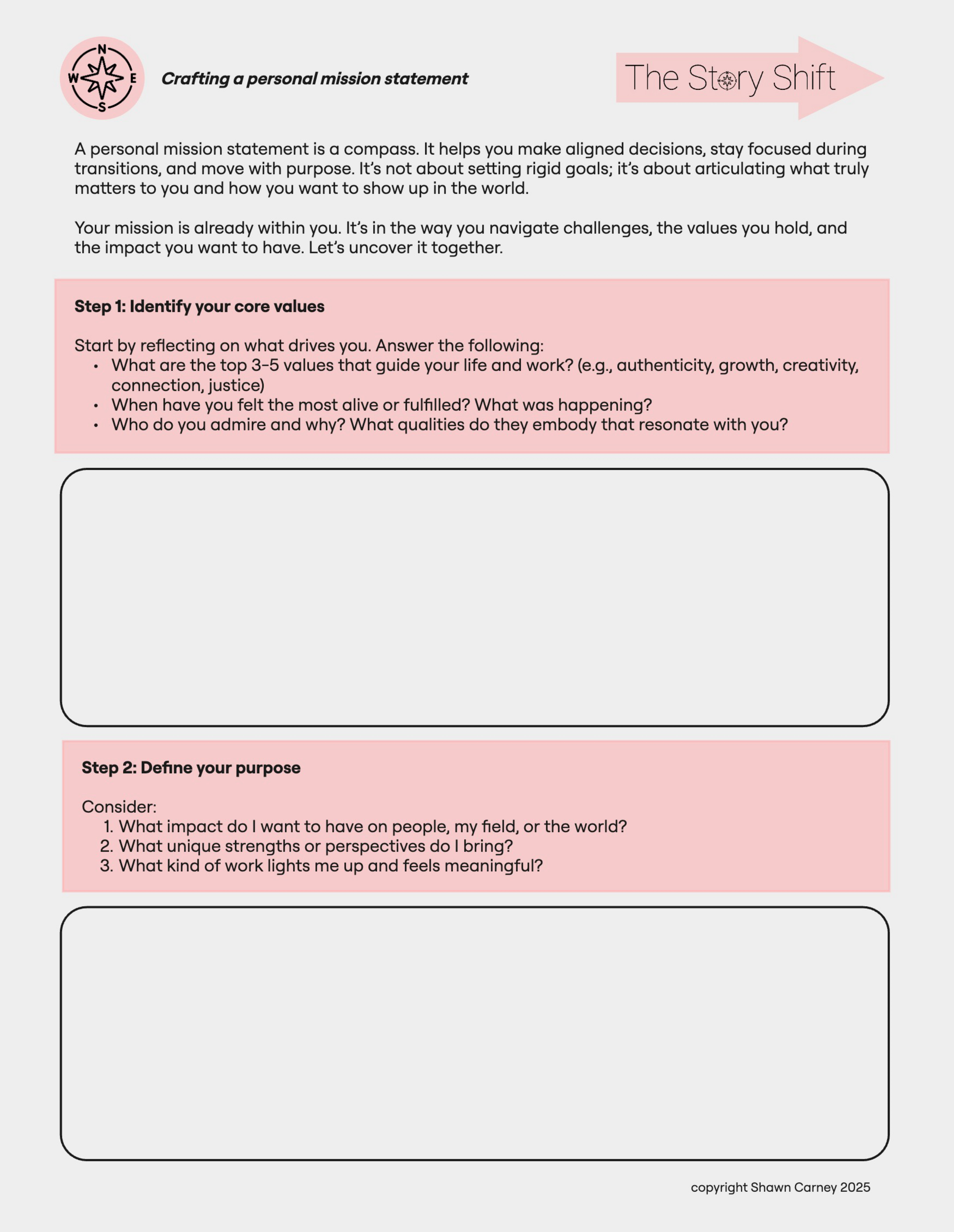
A personal mission statement is a compass. It helps you make aligned decisions, stay focused during transitions, and move with purpose. It’s not about setting rigid goals; it’s about articulating what truly matters to you and how you want to show up in the world.
Your mission is already within you. It’s in the way you navigate challenges, the values you hold, and the impact you want to have. Let’s uncover it together.
Step 1: Identify your core values
Start by reflecting on what drives you. Answer the following:
What are the top 3-5 values that guide your life and work? (e.g., authenticity, growth, creativity, connection, justice)
When have you felt the most alive or fulfilled? What was happening?
Who do you admire and why? What qualities do they embody that resonate with you?
Step 2: Define your purpose
Consider:
What impact do I want to have on people, my field, or the world?
What unique strengths or perspectives do I bring?
What kind of work lights me up and feels meaningful?
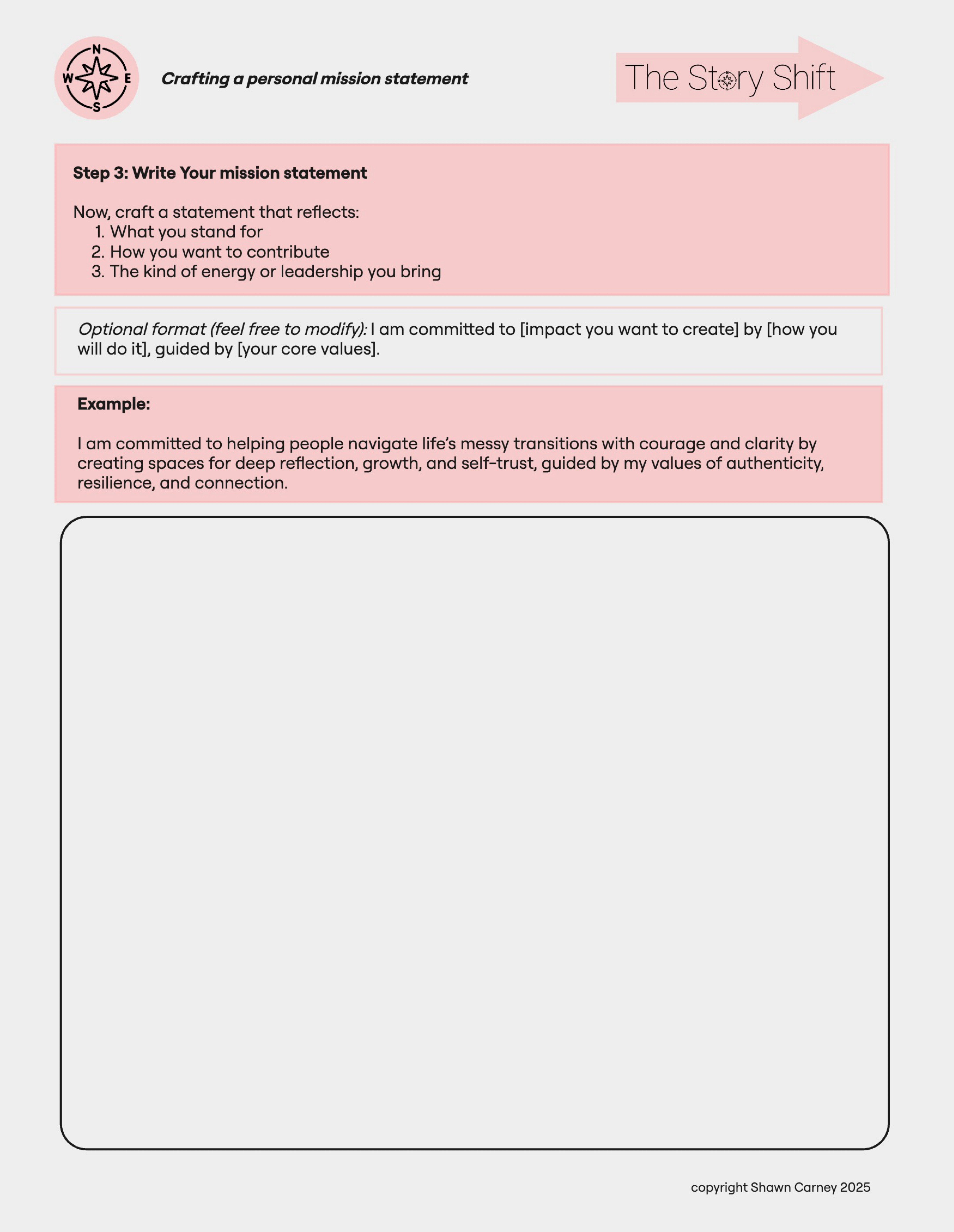
Step 3: Write your mission statement
Now, craft a statement that reflects:
What you stand for
How you want to contribute
The kind of energy or leadership you bring
Formula (feel free to modify!):
I am committed to [impact you want to create] by [how you will do it], guided by [your core values].
Example:
I am committed to helping people navigate life’s messy transitions with courage and clarity by creating spaces for deep reflection, growth, and self-trust, guided by my values of authenticity, resilience, and connection.
Exercise two: Storyboard your next chapter (visual or written)
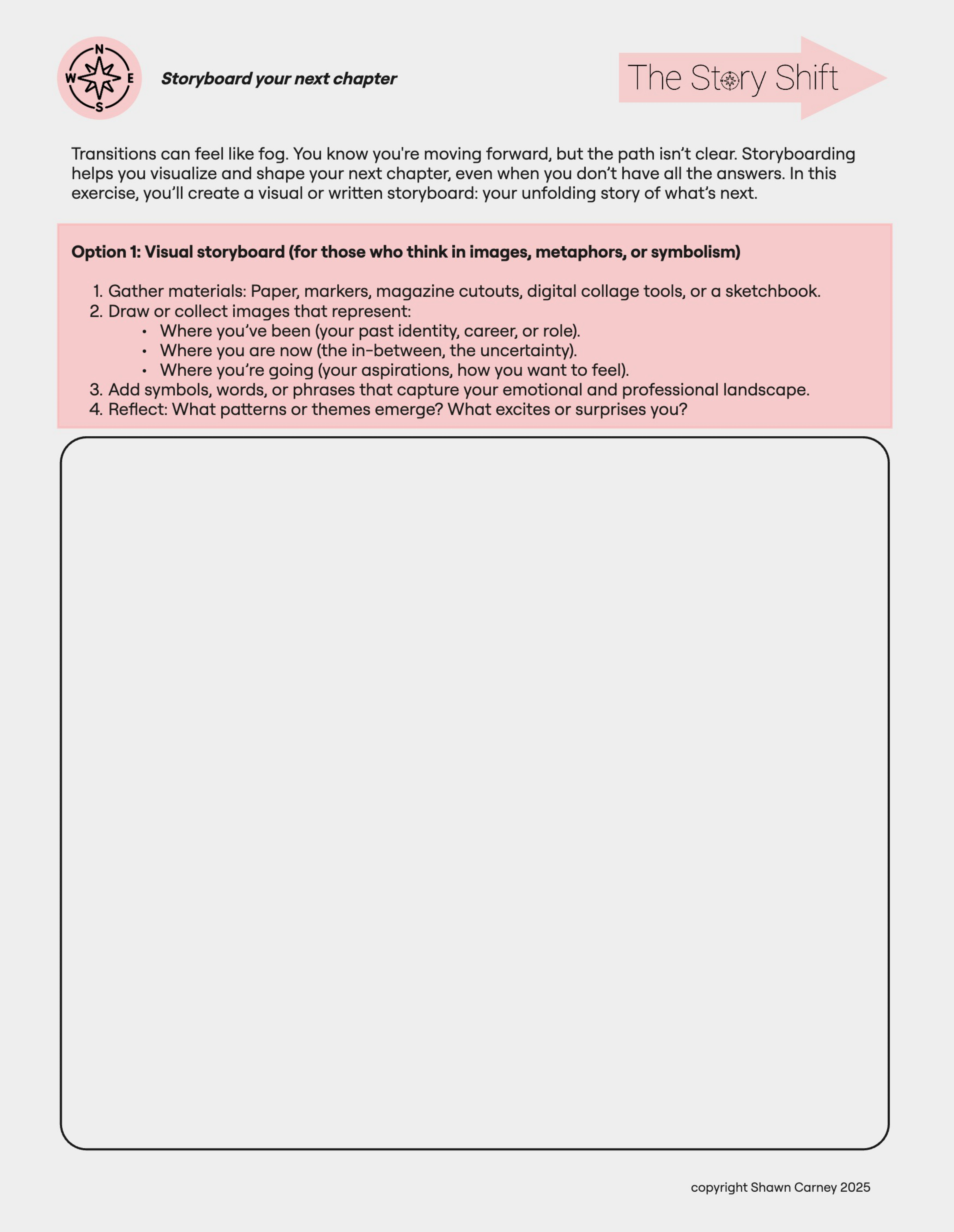
Transitions can feel like fog. You know you're moving forward, but the path isn’t clear. Storyboarding helps you visualize and shape your next chapter, even when you don’t have all the answers.
You’ll create a visual or written storyboard: your unfolding story of what’s next.
Option 1: Visual storyboard (for those who think in images, metaphors, or symbolism)
Gather materials: Paper, markers, magazine cutouts, digital collage tools, or a sketchbook.
Draw or collect images that represent:
Where you’ve been (your past identity, career, or role).
Where you are now (the in-between, the uncertainty).
Where you’re going (your aspirations, how you want to feel).
Add symbols, words, or phrases that capture your emotional and professional landscape.
Reflect: What patterns or themes emerge? What excites or surprises you?
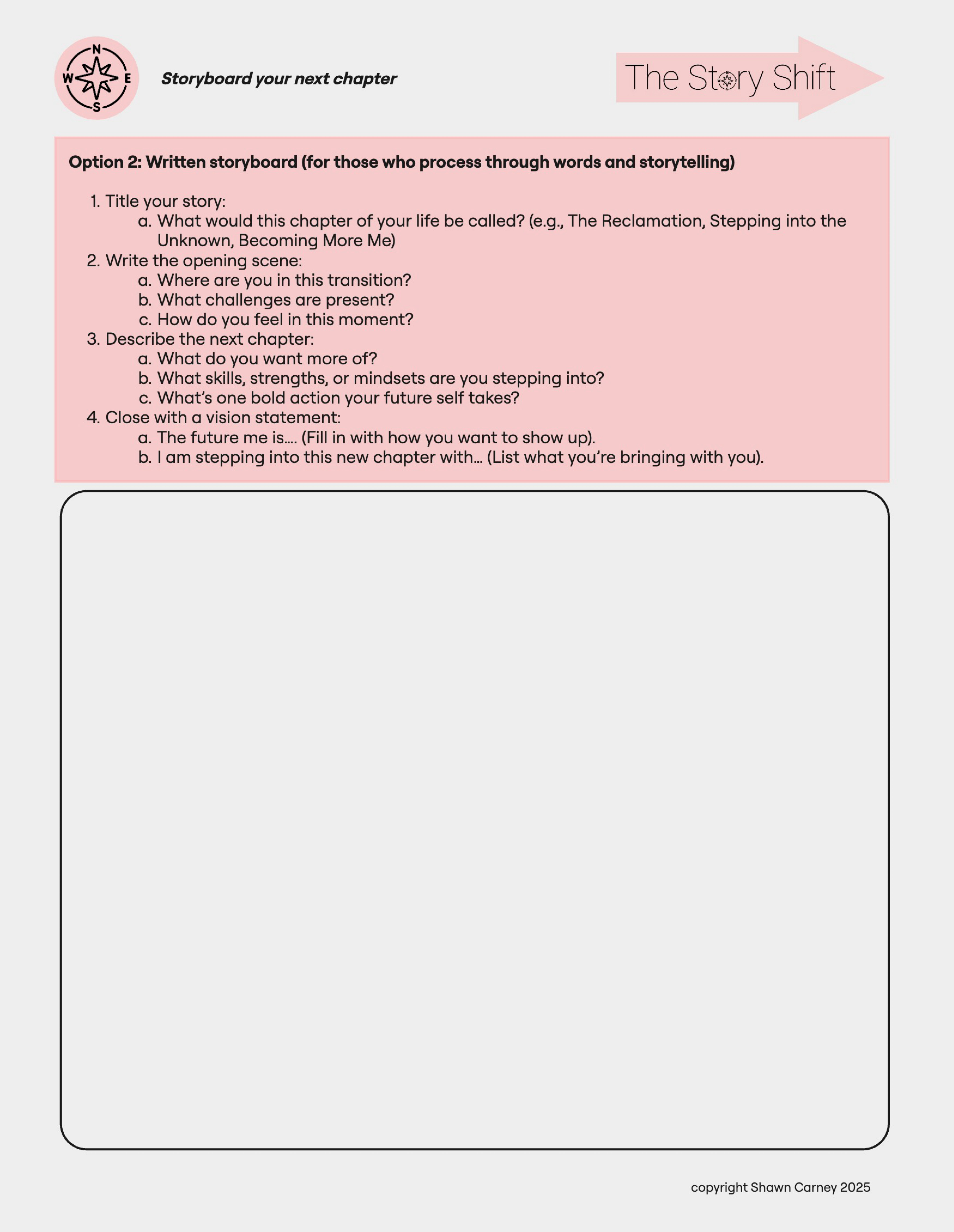
Option 2: Written storyboard (for those who process through words and storytelling)
Title your story: What would this chapter of your life be called? (e.g., The Reclamation, Stepping into the Unknown, Becoming More Me)
Write the opening scene:
Where are you in this transition?
What challenges are present?
How do you feel in this moment?
Describe the next chapter:
What do you want more of?
What skills, strengths, or mindsets are you stepping into?
What’s one bold action your future self takes?
Close with a vision statement:
The future me is…. (Fill in with how you want to show up).
I am stepping into this new chapter with… (List what you’re bringing with you).
Your story isn’t written yet, and that’s the beauty of it. You get to shape it, one decision, one belief, one action at a time.
Exercise three: The power of courageous steps
Transcript:
Fear is a part of every transition. Every single one. Even the ones we choose. The bigger the leap, the louder the fear. That’s not a sign you’re failing. It’s a sign you’re growing. The question isn’t ‘How do I get rid of fear?’ The question is ‘How do I move forward with it?’
Fear is sneaky; it disguises itself as self-doubt, perfectionism, procrastination. But underneath, it’s often the same message: ‘What if I’m not enough?’ ‘What if I fail?’ ‘What if I make the wrong choice?’ But here’s the thing: fear doesn’t predict the future. It only reflects what could go wrong. It never sees what could go right.
Take a moment to pause and reflect. What fear is most present for you right now? Name it. Write it down. Go ahead, I’ll wait.
Got it?
Fear’s job is to keep you safe. But safety isn’t the same as growth. Imagine if fear were just a warning light, not a stop sign, but a signal to check in. Here’s an exercise you can try:
Instead of saying, “I’m afraid I’ll fail”, try: “I am stepping into something new, and that takes courage.”
Instead of “I’m not ready”, try: “I’m in the process of becoming ready.”
Instead of “What if I make the wrong choice?” try: “Every choice teaches me something valuable.”
The antidote to fear is action. Not big, sweeping gestures, just one step forward. Fear shrinks when we take action, even small ones. So, what’s one thing you can do today to move toward your next chapter? Here’s some examples:
Send that email.
Write the mission statement.
Have that conversation.
Post that thing.
Research the opportunity.
Momentum builds when we choose movement over perfection. You don’t have to feel fearless to lead. You just have to take the next step, even with fear standing beside you. That’s courage. And courage is how we move forward.
So, what’s your next step?
As you close out this module, take a moment to honor how far you’ve come. You’ve moved through deep self-reflection, examined the stories that shape you, and begun aligning your actions with your evolving truth. In this fourth chapter, you’ve taken the brave step of looking forward, integrating your insights into a personal mission statement and envisioning your next chapter through storyboarding. These exercises aren’t about perfect answers or fixed outcomes; they’re about grounding your future in intention, clarity, and self-trust.
By naming what matters most to you, you’ve created a compass that can guide your choices, even when the road ahead feels uncertain. You’ve practiced imagining a future that feels resonant and real. Not in a distant or abstract way, but in a way that’s connected to the values, voice, and vision emerging through this process. And you’ve been reminded that courageous steps don’t have to be grand. They just need to be true.
Next week, we’ll move into the closing module of this journey. Together, we’ll reflect on what you’re carrying forward, what you’re leaving behind, and how to sustain momentum as your story continues to unfold. You’ve already done the hardest part: showing up with honesty and heart. Now it’s time to consider how to keep that aliveness with you as you cross the threshold into what’s next.
Between Chapters: The Story Shift
The Story Shift, Module One
The Story Shift, Module Two
The Story Shift, Module Three
The Story Shift, Module Four (this post)
Closing Out The Story Shift