

The Story Shift, Module Two
Where you are invited to take ownership and become the hero of your story, identifying your call to adventure, the allies who can support you, and the challenges you may need to face.

Welcome back!
In this module, we explore the power of narrative, not just as a way of describing your life and work, but as a tool for transformation. The stories we carry about ourselves, our worth, our capabilities, and our past shape what we believe is possible. Often, these stories are inherited, outdated, or rooted in moments of pain or disruption. Without realizing it, we can internalize narratives that keep us small, stuck, or disconnected from who we truly are becoming.
This isn’t about putting a positive spin on hard things or bypassing grief, doubt, or uncertainty. It’s about claiming authorship. It’s about recognizing that you have narrative agency: the ability to question and revise what no longer serves you, and to consciously choose stories that move you toward a life and career that feel aligned, alive, and meaningful.
We'll also explore how story lives not only in your mind but in your body. When you notice where you hold tension, resistance, or openness, you begin to access deeper layers of truth and power. By tuning into these cues, you can begin to shift the way you relate to your experiences and the future you're creating.
Let’s begin.
An introduction to the Hero’s Journey
Transcript:
We don’t just live our lives: we narrate them. And when big changes happen, we often feel like we’ve lost the plot. That’s why the hero’s journey can be a powerful framework for understanding career transitions. It helps us see that uncertainty, struggle, and reinvention aren’t signs of failure. They’re necessary parts of transformation.
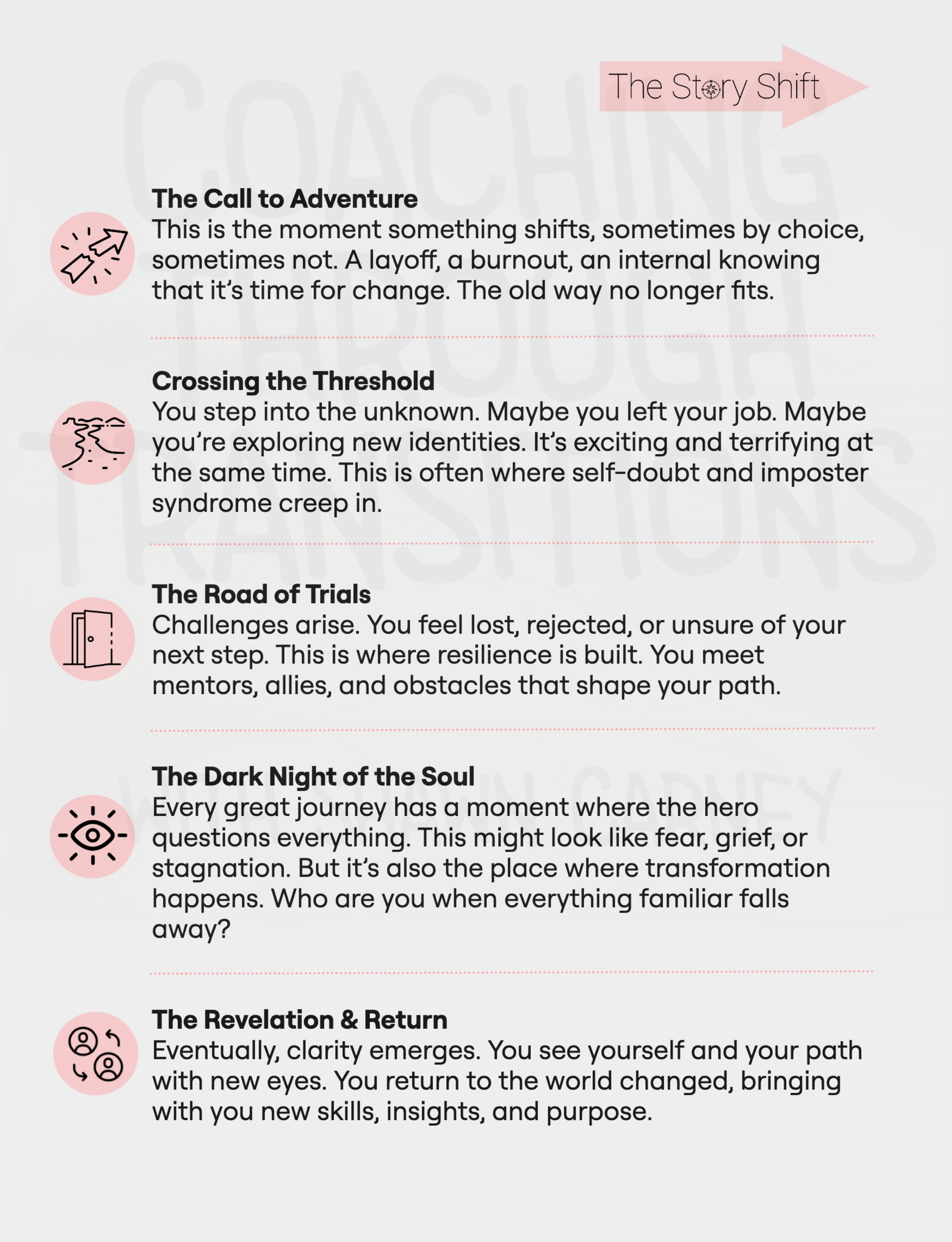
The hero’s journey is a pattern found in myths, stories, and even our own lives. It usually unfolds like this:
The Call to Adventure. This is the moment something shifts, sometimes by choice, sometimes not. A layoff, a burnout, an internal knowing that it’s time for change. The old way no longer fits.
Crossing the Threshold. You step into the unknown. Maybe you left your job. Maybe you’re exploring new identities. It’s exciting and terrifying at the same time. This is often where self-doubt and imposter syndrome creep in.
The Road of Trials. Challenges arise. You feel lost, rejected, or unsure of your next step. This is where resilience is built. You meet mentors, allies, and obstacles that shape your path.
The Dark Night of the Soul. Every great journey has a moment where the hero questions everything. This might look like fear, grief, or stagnation. But it’s also the place where transformation happens. Who are you when everything familiar falls away?
The Revelation & Return. Eventually, clarity emerges. You see yourself and your path with new eyes. You return to the world changed, bringing with you new skills, insights, and purpose.
Each of us is somewhere on this path. Maybe you’re at the beginning, still resisting the call to change. Maybe you’re deep in uncertainty, questioning everything. Maybe you’ve caught a glimpse of what’s next.
Wherever you are, know this: every stage is part of the story. You are not lost. You are becoming.
Over the next few modules, we’ll explore your journey in greater depth honoring where you’ve been, navigating where you are, and shaping where you want to go. Let’s begin.
Becoming the hero of your story
Transcript:
When change happens to us, especially when it’s unexpected, it’s so easy to feel like a victim. Like life has thrown us into a storm without a map, like we’ve lost control over our own story. And that’s valid. The emotions that come with that (grief, anger, fear) are real and they deserve space.
But what if I told you that this moment isn’t the end of your story? What if this transition, however painful or disorienting, is actually a call to adventure?
In every great story, the hero doesn’t start out as the hero. They start out as someone in their ordinary world, going about their life. Then something disrupts it; a loss, a challenge, a moment that forces them into the unknown. Sound familiar?
The difference between staying stuck in a victim mindset and stepping into a hero’s journey is perspective. It’s the shift from ‘Why is this happening to me?’ to ‘What if this is happening for me?’ Not in a toxic-positivity way, but in a way that honors your agency. Because even in uncertainty, you still have choices. You still have power.
Heroes don’t always feel ready when their journey begins. They doubt themselves. They resist. But they go forward anyway. They find allies, face challenges, and ultimately transform.
And you? You are in the middle of your own transformation.
So I want to invite you to think about your career transition not as an ending, but as a threshold. You are stepping into an unknown chapter, yes. But you are also stepping into possibility.
The story you tell yourself about this moment will shape how you move through it. Will you see yourself as someone who lost everything, or as someone who is being reshaped into something new? Will you stay at the threshold, or will you cross it?
In the next exercise, we’ll begin mapping your hero’s journey; identifying your call to adventure, the allies who can support you, and the challenges you may need to face. This is your chance to take ownership of your story.
You don’t have to have all the answers yet. But you do get to decide how you move forward. Let’s begin.
Exercise one: mapping your Hero’s Journey
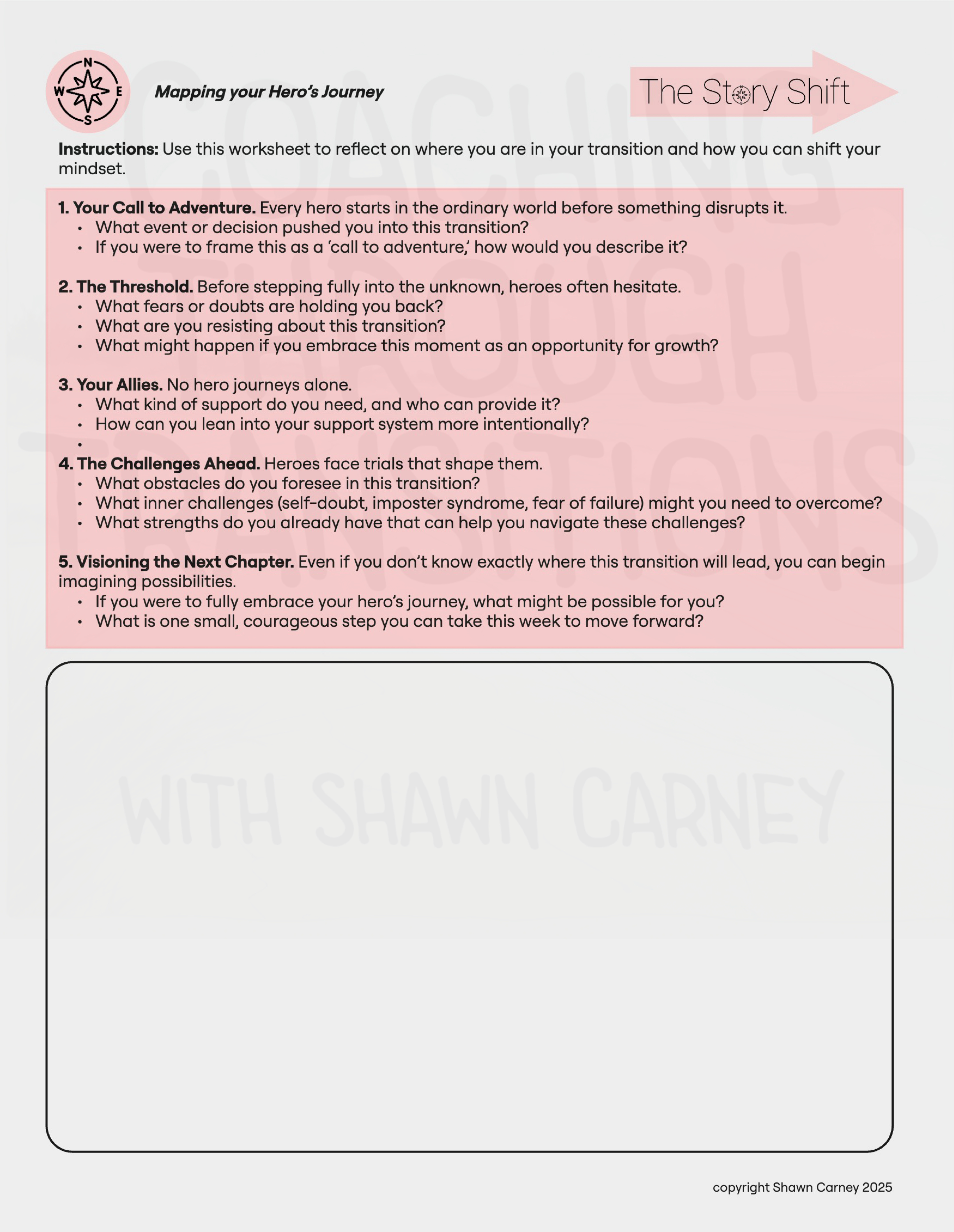
Instructions:
Use this worksheet to reflect on where you are in your transition and how you can shift your mindset, if needed.
1. Your Call to Adventure. Every hero starts in the ordinary world before something disrupts it.
What was your ‘ordinary world’ before this transition?
What event or decision pushed you into this transition?
If you were to frame this as a ‘call to adventure,’ how would you describe it?
2. The Threshold: Resistance & Fear. Before stepping fully into the unknown, heroes often hesitate.
What fears or doubts are holding you back?
What are you resisting about this transition?
What might happen if you embrace this moment as an opportunity for growth?
3. Your Allies. No hero journeys alone.
Who are the people who support you in this transition? (Mentors, friends, colleagues, coaches, family, etc.)
What kind of support do you need, and who can provide it?
How can you lean into your support system more intentionally?
4. The Challenges Ahead. Heroes face trials that shape them.
What obstacles do you foresee in this transition?
What inner challenges (self-doubt, imposter syndrome, fear of failure) might you need to overcome?
What strengths do you already have that can help you navigate these challenges?
5. Visioning the Next Chapter. Even if you don’t know exactly where this transition will lead, you can begin imagining possibilities.
If you were to fully embrace your hero’s journey, what might be possible for you?
What is one small, courageous step you can take this week to move forward?
Exercise two: embodiment practice
Find a quiet space. Get comfortable and take three slow breaths. Bring to mind a part of your story you’re ready to move into more fully.
Where do you feel it in your body?
What does it want to express, through posture, movement, or breath?
Let your body guide you for a few moments, then return and reflect: What did you learn?
Exercise three: what does success look like for the ‘future you’?
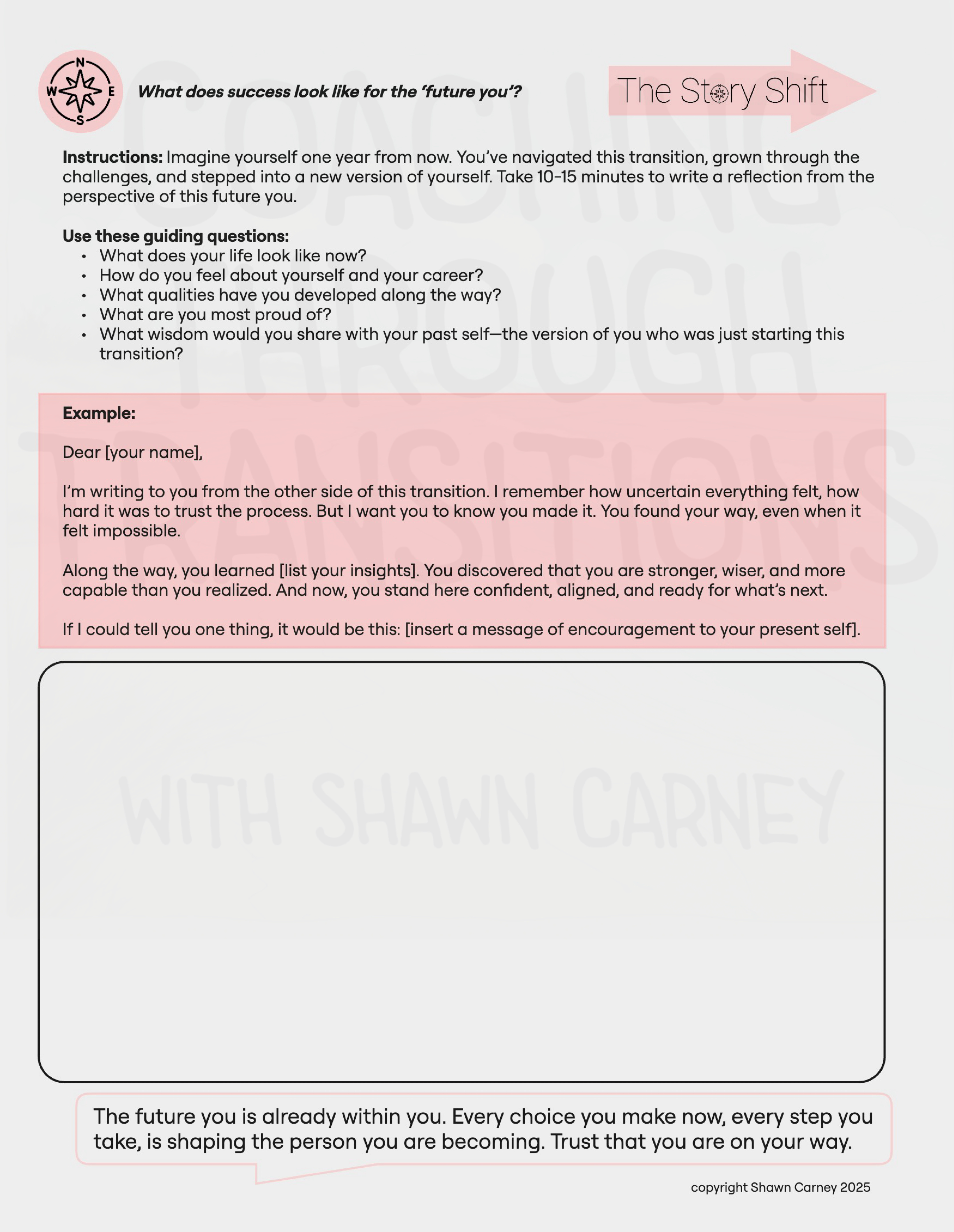
Prompt:
Imagine yourself one year from now. You’ve navigated this transition, grown through the challenges, and stepped into a new version of yourself. Take 10-15 minutes to write a reflection from the perspective of this future you.
Use these guiding questions:
What does your life look like now?
How do you feel about yourself and your career?
What qualities have you developed along the way?
What are you most proud of?
What wisdom would you share with your past self—the version of you who was just starting this transition?
Optional writing format:
Dear [your name],
I’m writing to you from the other side of this transition. I remember how uncertain everything felt, how hard it was to trust the process. But I want you to know: you made it. You found your way, even when it felt impossible. Along the way, you learned [list your insights]. You discovered that you are stronger, wiser, and more capable than you realized. And now, you stand here confident, aligned, and ready for what’s next.
If I could tell you one thing, it would be this: [insert a message of encouragement to your present self].
Closing thought:
The future you is already within you. Every choice you make now, every step you take, is shaping the person you are becoming. Trust that you are on your way.
Close out
As we wrap up module two, take a moment to acknowledge the work you’ve done! Not just intellectually, but emotionally. You’ve explored how narrative agency, intentional reframing, and somatic embodied awareness can help you reconnect to your sense of authorship. These aren’t one-time exercises; they are practices that deepen over time. Your story is living and evolving, and you have the capacity to shape it in ways that are aligned with your truth. Trust that even the small shifts matter.
Keep noticing what you’re carrying, what you’re shedding, and what’s calling to be rewritten. Remember, you’re encouraged to share in the comments any insights, observations, and questions you may have along the journey! The act of honoring your inner landscape (your emotions, your sensations, your beliefs) is a profound form of leadership. It’s from this place of grounded clarity that you’re better able to take meaningful action. And as always, you’re not navigating this alone.
In the next module, we’ll turn our focus from internal reflection to outer alignment. You’ve begun the work of rewriting your story, so next we’ll explore how to bring that story to life through your choices, commitments, and the environments you inhabit. Come back next week to explore how you live your values out loud, especially in complex or uncertain contexts.
Between Chapters: The Story Shift
The Story Shift, Module One
The Story Shift, Module Two (this post)
The Story Shift, Module Three
The Story Shift, Module Four
Closing Out The Story Shift