

The Story Shift, Module Three
Where you are invited to align your actions with your evolving story to live your values with intention.

Welcome back!
Now that you’ve started the work of reclaiming and reshaping your story, this module invites you to take that inner clarity and bring it into your outer world. What does it look like to live in alignment with your values and narrative? How do your decisions, boundaries, and goals reflect who you're becoming?
This module focuses on congruence: closing the gap between your inner voice and your external choices. You’ll explore how to make decisions that honor your evolving story, even when the path ahead feels uncertain. We’ll also consider what environments, relationships, and habits support your next chapter and which ones may need to shift.
Let’s begin.
Exercise one: identifying and befriending your inner saboteurs
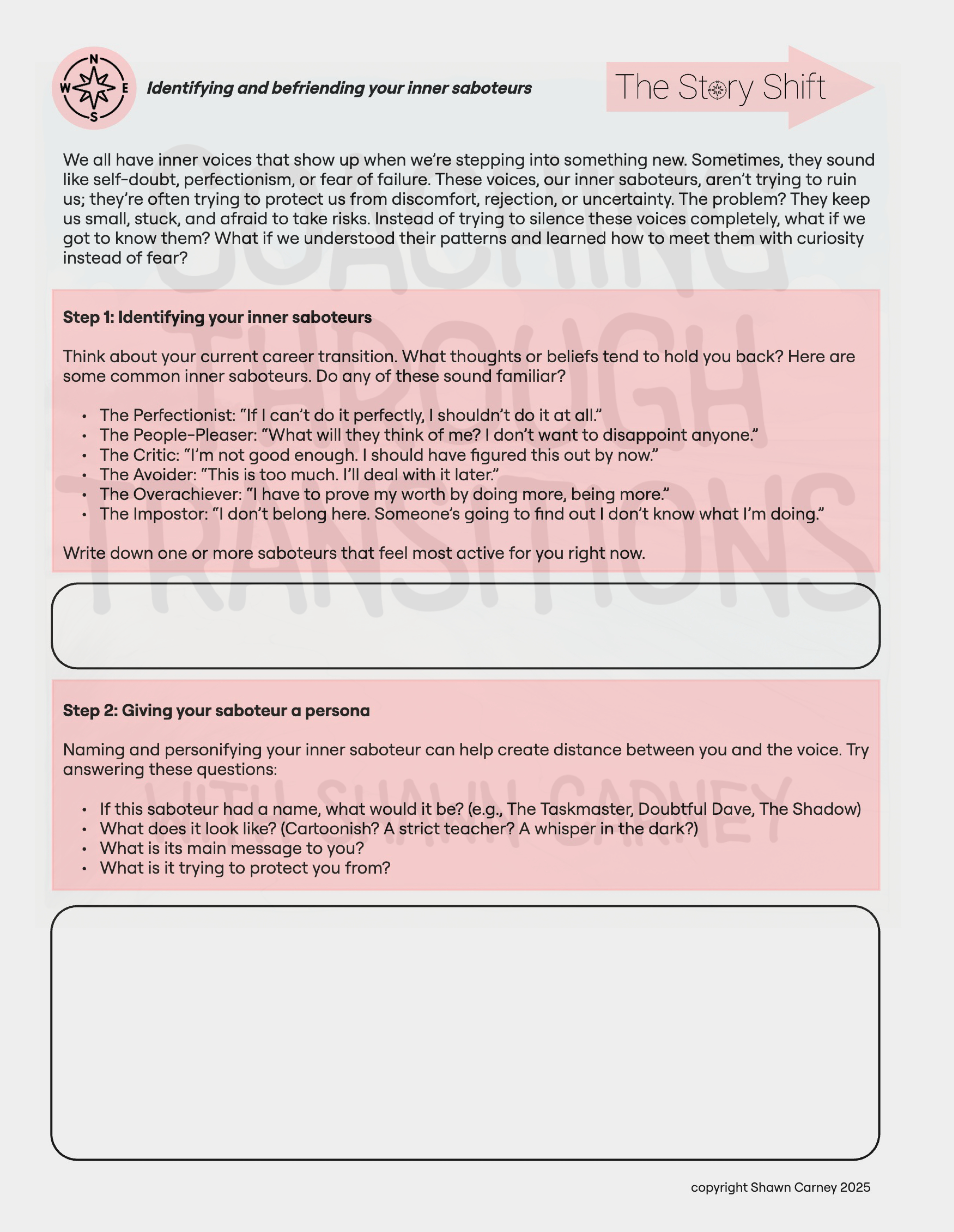
We all have inner voices that show up when we’re stepping into something new. Sometimes, they sound like self-doubt, perfectionism, or fear of failure. These voices (our inner saboteurs) aren’t trying to ruin us; they’re often trying to protect us from discomfort, rejection, or uncertainty. The problem? They keep us small, stuck, and afraid to take risks.
Instead of trying to silence these voices completely, what if we got to know them? What if we understood their patterns and learned how to meet them with curiosity instead of fear?
Step 1: Identifying your inner saboteurs
Think about your current career transition. What thoughts or beliefs tend to hold you back? Here are some common inner saboteurs. Do any of these sound familiar?
The Perfectionist: If I can’t do it perfectly, I shouldn’t do it at all.
The People-Pleaser: What will they think of me? I don’t want to disappoint anyone.
The Critic: I’m not good enough. I should have figured this out by now.
The Avoider: This is too much. I’ll deal with it later.
The Overachiever: I have to prove my worth by doing more, being more.
The Impostor: I don’t belong here. Someone’s going to find out I don’t know what I’m doing.
Write down one or more saboteurs that feel most active for you right now.
Step 2: Giving your saboteur a persona
Naming and personifying your inner saboteur can help create distance between you and the voice. Try answering these questions:
If this saboteur had a name, what would it be? (e.g., The Taskmaster, Doubtful Dave, The Shadow)
What does it look like? (Cartoonish? A strict teacher? A whisper in the dark?)
What is its main message to you?
What is it trying to protect you from?
Step 3: Befriending your saboteur
Now, instead of battling this voice, get curious about it. Ask it:
What do you want for me?
What are you afraid of?
How can I work with you instead of against you?
Write a short response from your saboteur’s perspective. Then, write a response to it, reassuring it that you hear its concerns but that you’re still moving forward.
Closing thought:
Your saboteurs are not the enemy. They are untrained messengers. When you meet them with curiosity, you start to take away their power and reclaim your own.
Exercise two: what anchors you during the storm?
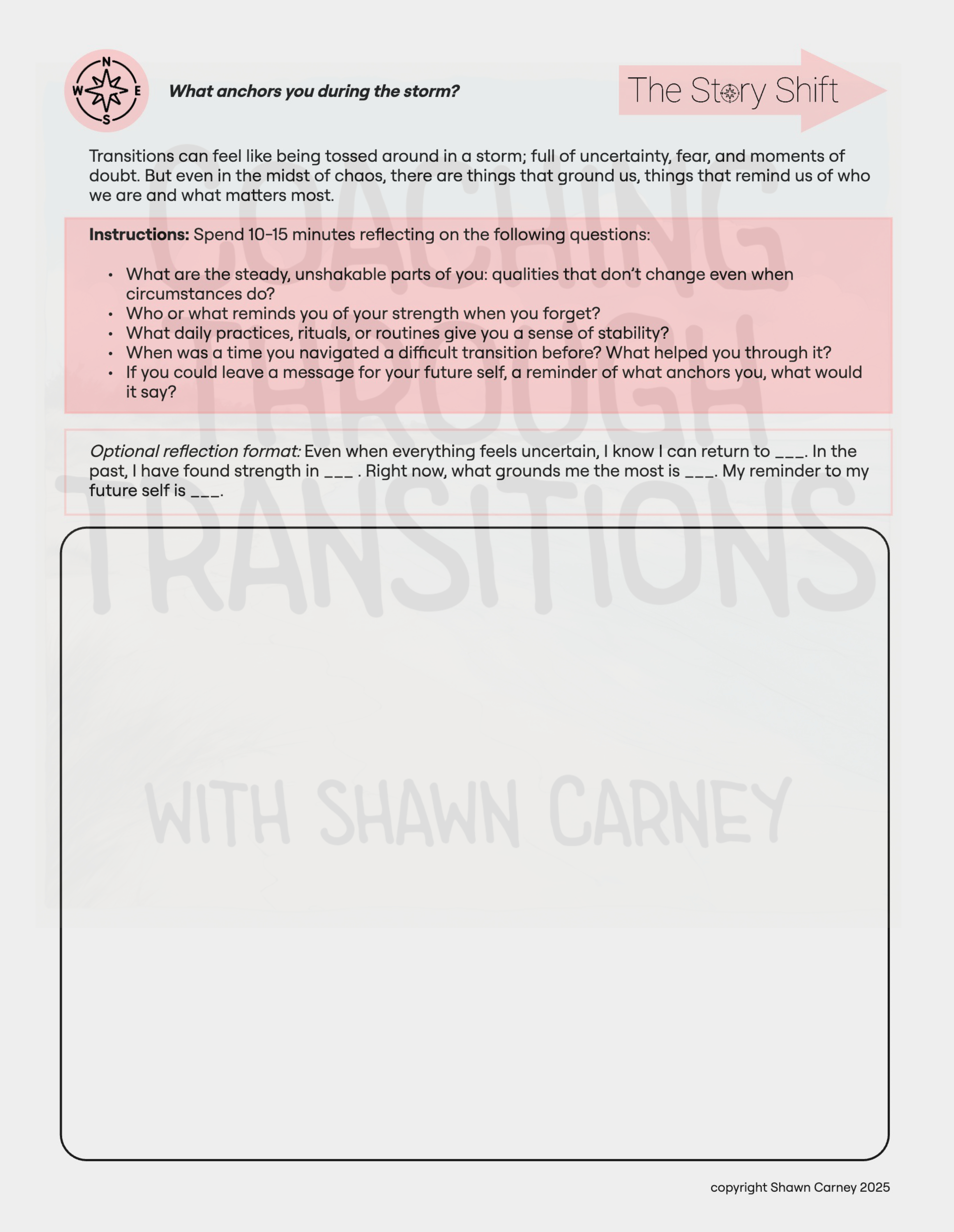
Transitions can feel like being tossed around in a storm, full of uncertainty, fear, and moments of doubt. But even in the midst of chaos, there are things that ground us, things that remind us of who we are and what matters most.
Instructions: Spend 10-15 minutes reflecting on the following questions:
What are the steady, unshakable parts of you? What are the qualities that don’t change even when circumstances do?
Who or what reminds you of your strength when you forget?
What daily practices, rituals, or routines give you a sense of stability?
When was a time you previously navigated a difficult transition? What helped you through it?
If you could leave a message for your future self, a reminder of what anchors you, what would it say?
Optional reflection format:
Even when everything feels uncertain, I know I can return to ___. In the past, I have found strength in ___. Right now, what grounds me the most is ___. My reminder to my future self is this: ___.
Bonus: micro-practices for resilience
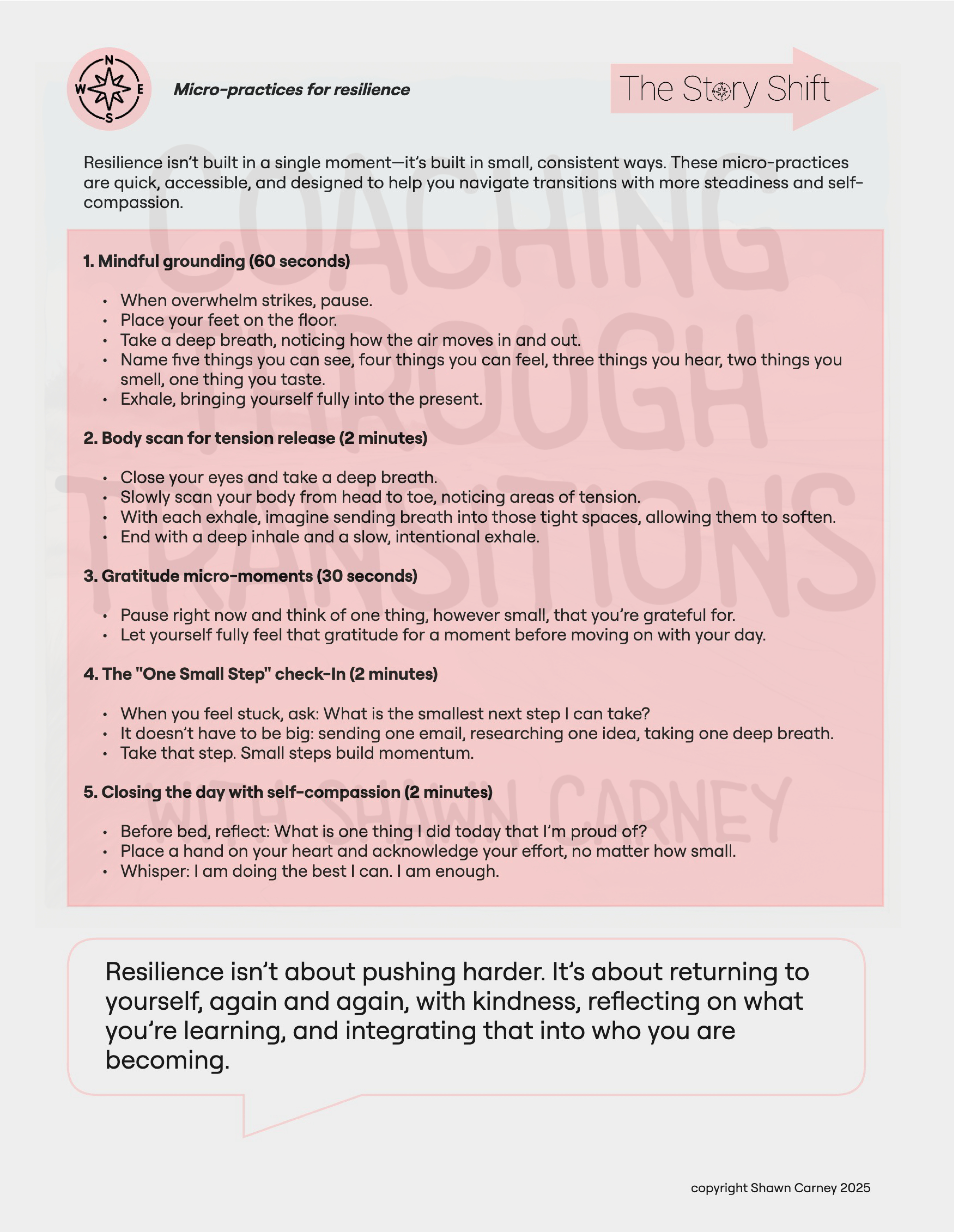
Resilience isn’t built in a single moment; it’s built in small, consistent ways. These micro-practices are quick, accessible, and designed to help you navigate transitions with more steadiness and self-compassion.
1. Mindful grounding (60 Seconds)
When overwhelm strikes, pause.
Place your feet on the floor.
Take a deep breath, noticing how the air moves in and out.
Name five things you can see, four things you can feel, three things you hear, two things you smell, one thing you taste.
Exhale, bringing yourself fully into the present.
2. Body scan for tension release (2 Minutes)
Close your eyes and take a deep breath.
Slowly scan your body from head to toe, noticing areas of tension.
With each exhale, imagine sending breath into those tight spaces, allowing them to soften.
End with a deep inhale and a slow, intentional exhale.
3. Gratitude micro-moments (30 Seconds)
Pause right now and think of one thing, however small, that you’re grateful for.
Let yourself fully feel that gratitude for a moment before moving on with your day.
4. The one small step check-in (2 Minutes)
When you feel stuck, ask: What is the smallest next step I can take?
It doesn’t have to be big, sending one email, researching one idea, taking one deep breath.
Take that step. Small steps build momentum.
5. Closing the day with self-compassion (2 Minutes)
Before bed, reflect: What is one thing I did today that I’m proud of?
Place a hand on your heart and acknowledge your effort, no matter how small.
Whisper to yourself: I am doing the best I can. I am enough.
Final thought:
Resilience isn’t about pushing harder. It’s about returning to yourself, again and again, with kindness, reflecting on what you’re learning, and integrating that into who you are becoming.
You’ve made it three quarters of the way through the course! Take a breath and really let that land. The inner work you’ve done so far hasn’t been light. You’ve reflected, rewritten, and reconnected with parts of yourself that may have been quiet for a long time. That’s no small thing. It takes courage to turn inward, to challenge old narratives, and to imagine something different for your life and leadership. So pause here and truly acknowledge your commitment to this journey.
In this module, you explored what it means to move from clarity into action. You began to close the gap between who you are becoming and how you show up in the world. That process isn’t about perfection, it’s about presence and practice. It's about choosing actions, habits, and environments that reflect the story you're actively writing, even in the face of uncertainty or discomfort. You’ve taken important steps toward making your values visible, and aligning your energy with what matters most.
You’ve also begun to notice what supports your growth and what no longer fits. Sometimes that means saying no, creating new boundaries, or letting go of roles and responsibilities that no longer serve your evolving story. These choices can feel risky, but they are essential acts of self-trust.
Keep listening inward. Let your story guide your next steps. Use the comments section for any questions, observations, or insights that may arise. Take a moment to introduce yourself and share anything that you’re learning along this journey. You’re not alone here and you’re welcome to explore together and respond to each other.
As we move into the second half of the course, we’ll continue building on this foundation: deepening your integration and anchoring your leadership in resilience, connection, and truth. Not as a way to push through or toughen up, but as a grounded practice of staying connected to yourself in the midst of change, complexity, and uncertainty. True resilience isn’t about avoiding struggle; it’s about learning how to meet life as it is, with presence, adaptability, and care. In the next module, we’ll explore how to cultivate internal resources, recover from setbacks, and sustain your energy as you continue living your story out loud.
Between Chapters: The Story Shift
The Story Shift, Module One
The Story Shift, Module Two
The Story Shift, Module Three (this post)
The Story Shift, Module Four
Closing Out The Story Shift